Curriculum Intent
Humberston Cloverfields is an enquiry driven school; we believe that learning is much more than just retaining knowledge and we recognise that our role is to develop learners for the 21st Century.
Our children are very well prepared for the next stages in their education as we work hard give them a secure grounding in basic skills, including reading, writing, spelling, grammar, secure mathematical understanding and confidence in the use of ICT. We firmly believe in furnishing our young people with a set of learning tools, attitudes and habits that they will be able to use throughout their lives, even when faced with unfamiliar challenges. We believe in delivering a curriculum that is designed to meet the needs of OUR children and serves to challenge them to reach their full potential academically, socially and emotionally.
Developing Respectful Thinkers and Learners
There is an emphasis on quality across the curriculum. ‘Fewer things in better quality’ is a focus in classrooms and allows us to develop a depth of learning.
The theory behind ‘Austin’s Butterfly’ is our mantra when it comes to improving performance; pupils support each other with clear and precise guidance for improvement through Critique. We believe in developing a ‘mastery of learning’ approach so every child is challenged and supported to a secure foundation of understanding. Strategies are used to ensure they are given a chance to practise and perfect performance; Critique and Collaboration are key. We recognise children grasp learning in different ways and at different speeds and our practice reflects this.
We also ensure they are respectful and tolerant members of society, by developing an understanding of different beliefs and cultures; this is reflected in our spiritual, moral, social and cultural curriculum.
Curriculum Content
We have chosen to devise a knowledge-based curriculum in line with the skills promoted in both, the National Curriculum and the Early Years Foundation Stage Framework as this suits the needs of our pupils. We identify non-negotiable facts to learn, which contributes to their general knowledge. This enables pupils to grow on a personal and academic level, allowing them to perceive, understand and analyse situations effectively. We focus on planning an academic grounding for children that meets their needs in the world they live in and allows them to make progress with us and beyond in the next stage of their education. Three subjects drive our curriculum: history, geography and science. Geography ensures pupils develop key knowledge of the local area and the wider world, while history teaches how significant individuals and events from the past have helped shape it. Science and DT provide essential knowledge and skills necessary for future careers in the 21st century, in industries along the Humber Bank.
In addition to the academic curriculum, we provide children with a Humberston Cloverfields Experience that ensures they know their place in the world and is built on the belief that key activities, visits and experiences are key to childhood enjoyment and learning. Please see the document detailing this.
Curriculum Approach
We have a whole school themed approach to the curriculum, which is driven by enquiry questions, specific to each cohort. The curriculum is organised on a two-year cycle. We ensure that all learning is purposeful and every cohort uses a quality text as the stimulus for each theme. In addition to this, the school uses the Enquire Computing Curriculum and follows the Lincolnshire Locally Agreed Syllabus for Religious Education.
Curriculum Planning
The timing of each topic, and the length of time each topic lasts for, is driven by the needs of the children. Learning teams work together to plan the curriculum for the term. A People Day, where each phase learns about a significant individual linked to the driving subject, is used to start each topic. This ensures the children develop knowledge of key individuals, who have shaped the world they live in. Topics are sequential in content and allow for knowledge and key concepts to be revisited and built upon.
Curriculum Monitoring
Areas of the Curriculum are monitored by teams of staff. They use a variety of Curriculum Monitoring processes to ensure coverage, progression and high standards in their areas. Standards attained in the core subjects are demanded in cross curricular work.
Details of individual National Curriculum subjects for each academic year group can be found at: https://www.gov.uk/government/collections/national-curriculum
Parent Maps
Why Times Tables Matter in the Primary Maths Curriculum
Times tables are a vital foundation of the primary maths curriculum. When children develop quick and accurate recall of multiplication facts, they free up their working memory for more complex mathematical thinking. This fluency supports efficient written and mental calculation, strengthens problem‑solving skills, and underpins later topics such as fractions, area, ratio, algebra, and proportional reasoning.
Strong times tables knowledge boosts confidence too. When children no longer need to pause and count in steps, they can approach new learning with greater independence and resilience. For these reasons, national curriculum expectations place a clear emphasis on multiplication fluency by the end of Year 4, supported by the statutory Multiplication Tables Check (MTC).
Using Times Table Rock Stars: Developing Speed and Recall
To complement our structured teaching, we also use Times Table Rock Stars (TTRS) across the school.
TTRS provides a fun, motivating platform for pupils to practise and rehearse multiplication facts at speed, helping them strengthen automatic recall. The game‑based approach encourages regular practice in short bursts—ideal for building confidence and fluency.
We use TTRS in parallel with the Times Tables Fluency Programme:
- The programme develops understanding, strategies and deep conceptual knowledge.
- TTRS builds the speed and accuracy needed for automatic recall.
By combining these two approaches, pupils benefit from both secure understanding and increasing fluency—ensuring they can recall multiplication facts rapidly and confidently, and apply them effectively across the maths curriculum.
Oracy
What is oracy?
Oracy is the ability to articulate ideas, develop understanding and engage with others through spoken language.
In school, oracy is a powerful tool for learning; by teaching students to become more effective speakers and listeners we empower them to better understand themselves, each other and the world around them. It is also a route to social mobility, empowering all students, not just some, to find their voice to succeed in school and life.
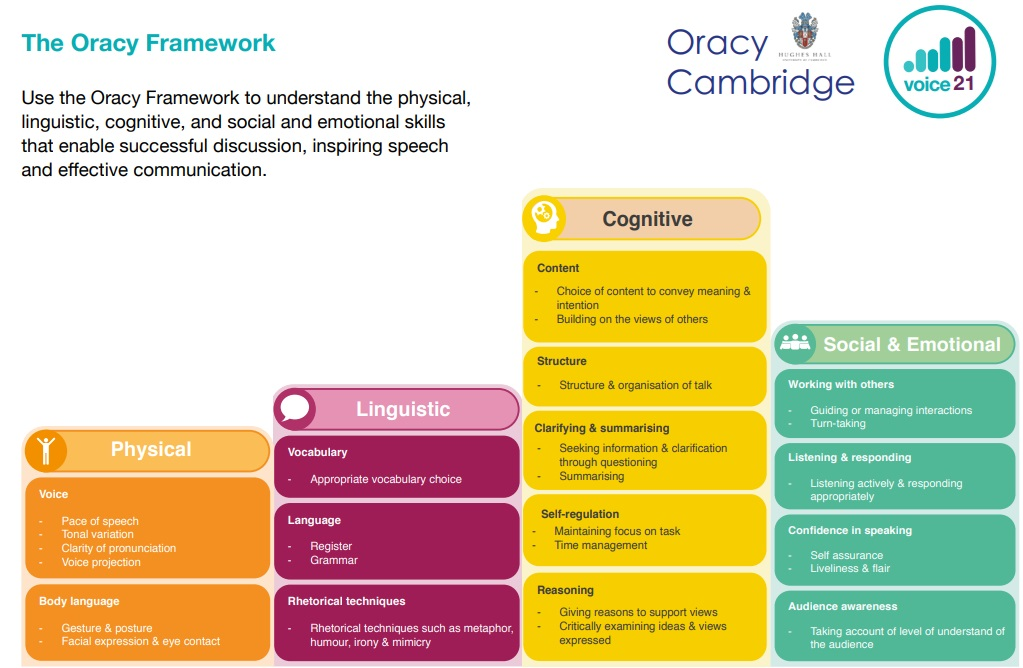
The Oracy Framework
Humberston Cloverfields Academy is working with the Voice 21 project and using The Oracy Framework, devised by Voice 21 and Oracy Cambridge. This provides a structure through which we can understand what constitutes good speaking and listening in different contexts. It breaks down the skills within oracy into four distinct but interlinked strands: physical, linguistic, cognitive and social & emotional.
In September 2026 we introduced Kinetic Letters as our new handwriting curriculum. This programme covers four key strands:

The benefits of our Kinetic Letters handwriting curriculum are:
- Automaticity – Formation, orientation and placement of letters becomes automatic which frees up space in the working memory.
- Achievement – Fast, legible and fluent handwriting underpins success in every curriculum area.
- Confidence – Good handwriting creates a positive initial judgement.
- Creativity – When handwriting is automatic, the brain can concentrate on content.
- Reading – Writing and reading are reciprocal skills, so improvement in one, helps the other.
- Phonics and Spelling – legible handwriting means children can read and correct spelling.
Nursery
Reception
Intent:
At Humberston Cloverfields, we believe that it is vital for all our pupils to learn from and about Computing and Technology, so that they can understand the world around them. Through teaching our computing curriculum, we aim to equip our children to participate in a rapidly changing world where work and leisure activities are increasingly transformed by technology. It is our intention to enable children to find, explore, analyse, exchange and present information as well as having the skills to manipulate, develop and interpret different forms of technology in an ever-changing world.
In such a fast-moving curriculum, we are constantly looking at new ways of delivering relevant and exciting activities, while still delivering the fundamental skills needed for computing. Using technology safely and responsibly is a main priority and ensuring all pupils are able to use the internet and equipment appropriately is of paramount importance. We encourage our pupils to make links across the curriculum, the world and our local community, to reflect on their own experiences, which are designed in our curriculum, allowing horizontal and vertical links with previous year groups.
The core of computing is computer science, in which pupils are taught the principles of information and computation, how digital systems work, and how to put this knowledge to use through programming. Building on this knowledge and understanding, pupils are equipped to use information technology to create programs, systems and a range of content. Computing also ensures that pupils become digitally literate – able to use, and express themselves and develop their ideas through, information and communication technology – at a level suitable for the future workplace and as active participants in a digital world.
Our ambitious computing curriculum is now structured in 3 areas that allow all pupils from EY to year 6 to progress through different categories of knowledge. These are:
- Digital Literacy
- Information Technology
- Computer Science
Each area of the curriculum gives pupils time to practice and rehearse the knowledge needed to be proficient at computing and be ready for the next age of learning.
Implementation:
The Enquire Learning Trust bespoke computing curriculum offers a cross curricular scheme of work for EYFS, Key Stage 1 and Key Stage 2 which matches the expectations of the National Curriculum. The curriculum looks at the progression needed for all pupils to develop and embed skills and knowledge within the strands of: computer science, information technology and digital literacy. The curriculum is designed to support teaching and learning and the acquisition of subject knowledge in all areas. Children will have the opportunity to explore and respond to key issues such as digital communication, cyber-bullying, online safety, security and social media.
Impact:
The impact this curriculum will have shows that:
- Children will be confident users of technology, able to use it to accomplish a wide variety of goals, both in school and at home.
- Children will have a secure and comprehensive knowledge of the implications of technology and digital systems which is important in our ever-evolving society.
- Children will be able to apply the British Values of democracy, tolerance, mutual respect, rule of law and liberty when using digital systems.
- Solve problems in computational terms, and have repeated practical experience of writing computer programs in order to solve such problems
- Can evaluate and apply information technology, including new or unfamiliar technologies, analytically to solve problems
- Are responsible, competent, confident and creative users of information and communication technology.
Our Design and technology curriculum enables pupils to meet the Early Learning Goals and the end of key stage attainment targets in the National curriculum. The aims of our curriculum also align with those in the National curriculum.
Implementation:
Our Design and technology curriculum outlines the three main stages of the design process: design, make and evaluate. Each stage of the design process is underpinned by technical knowledge which encompasses the contextual, historical, and technical understanding required for each strand. Cooking and nutrition has a separate section, with a focus on specific principles, skills and techniques in food, including where food comes from, diet and seasonality.
The National curriculum organises the Design and technology attainment targets under five subheadings or strands:
• Design
• Make
• Evaluate
• Technical knowledge
• Cooking and nutrition
Our Design and technology curriculum has a clear progression of skills and knowledge within these five strands across each year group. Our Progression of skills shows the skills and knowledge that are taught within each year group and how these skills develop to ensure that attainment targets are securely met by the end of each key stage.
Through our Design and technology scheme, pupils respond to design briefs and scenarios that require consideration of the needs of others, developing their skills in five key areas:
• Mechanisms
• Structures
• Textiles
• Food and
• Electrical systems (KS2)
Each of our key areas follows the design process (design, make and evaluate) and has a particular theme and focus from the technical knowledge or cooking and nutrition section of the curriculum. Our curriculum is a spiral curriculum, with key areas revisited again and again with increasing complexity, allowing pupils to revisit and build on their previous learning.
Lessons incorporate a range of teaching strategies from independent tasks, paired and group work including practical hands-on, computer-based and inventive tasks.
Differentiated guidance is available for every lesson to ensure that lessons can be accessed by all pupils and opportunities to stretch pupils’ learning are available when required. Knowledge organisers for each unit support pupils in building a foundation of knowledge by encouraging recall of key facts and vocabulary.
Strong subject knowledge is vital for staff to be able to deliver a highly effective and robust Design and technology curriculum. To ensure this, each unit of lessons in our curriculum includes multiple teacher videos to develop subject knowledge and support ongoing CPD.
Impact:
The impact of our curriculum is be constantly monitored through both formative and summative assessment opportunities.
Each lesson plan includes guidance to support teachers in assessing pupils against the learning objectives. Furthermore, each unit has a unit quiz which is used at the end of the unit to assess technical knowledge. Teachers can also assess children’s through evaluation of final products against design criteria.
After the implementation of our Design and technology curriculum, pupils should leave school equipped with a range of skills to enable them to succeed in their secondary education and be innovative and resourceful members of society.
The expected impact our Design and technology curriculum is that children will:
• Understand the functional and aesthetic properties of a range of materials and resources.
• Understand how to use and combine tools to carry out different processes for shaping, decorating, and manufacturing products.
• Build and apply a repertoire of skills, knowledge and understanding to produce high quality, innovative outcomes, including models, prototypes, CAD, and products to fulfil the needs of users, clients, and scenarios.
• Understand and apply the principles of healthy eating, diets, and recipes, including key processes, food groups and cooking equipment.
• Have an appreciation for key individuals, inventions, and events in history and of today that impact our world.
• Recognise where our decisions can impact the wider world in terms of community, social and environmental issues.
• Self-evaluate and reflect on learning at different stages and identify areas to improve.
• Meet the end of key stage expectations outlined in the National curriculum for Design and technology.
At Humberston Cloverfields Academy, our aim is to develop children’s learning of the French language and the understanding of its culture in an enjoyable and stimulating way for all pupils.
Our aim is that learners will:
- make substantial progress in learning French and meet the targets of the KS2 Programme of Study.
- become resilient, independent learners who enjoy language learning and acquire language learning skills and strategies that allow them to succeed, including what to do when faced with unfamiliar language, memorisation and retrieval.
- develop the skill of using a bilingual dictionary and reference materials.
- manipulate language to speak or write French using their knowledge of features of French including grammar.
- recognise similarities and differences between English (and other languages they speak) and French.
- notice patterns and key sounds in French, including graphemes used to represent them, and apply them to speaking listening and reading aloud.
- appreciate and join in with songs, rhymes and stories, moving from copying sounds to adapting them through substitution and expansion.
- have a deeper understanding of cultural differences and similarities, including French as a world language.
Implementation:
Long term planning is in place to ensure coverage and progression of skills and knowledge required in the National Curriculum.
We value active learning opportunities to immerse children fully into the learning experience and strive to provide creative opportunities, where they will build on prior learning and take risks. The Language Angels scheme provides opportunities to listen to spoken language and the children can respond and collaborate to build their confidence. Over time, the careful progression of skills allows children to explore and learn patterns and sounds in the language, and to link the spellings and meaning of words in French. They also learn to read and understand an increasing vocabulary and some phrases to use in simple writing. There are cross-curricular links to everyday life, school, and the French culture. There is a careful progression of learning (broken down into phonics, vocabulary, and grammar knowledge) starting in year 3 and following through to the end of year 6.
Impact:
The impact of our MFL curriculum is constantly monitored through both formative and summative assessment opportunities. We use Enquire Learning Trust’s foundation subject assessment system, which shows pupils’ understanding in phonics, grammar and vocabulary. It identifies next steps for learning and areas to be the focus of retrieval practice to ensure pupils know more and remember more in MFL.
Finding Out More
If you would like to find out more about PSHE or the Jigsaw programme, please speak to your child's class teacher in the first instance. They will be happy to explain what your child is learning and answer any questions you may have.
You can also contact the school's PSHE lead or a member of the leadership team, who can provide further information about how Jigsaw is taught at Humberston Cloverfields Academy and how the programme supports the needs of our children and community.
Further information about the Jigsaw programme can be found on the Jigsaw PSHE website.
At Humberston Cloverfields Academy, we value the partnership between home and school and welcome any questions or discussions about your child's personal development, wellbeing and learning.